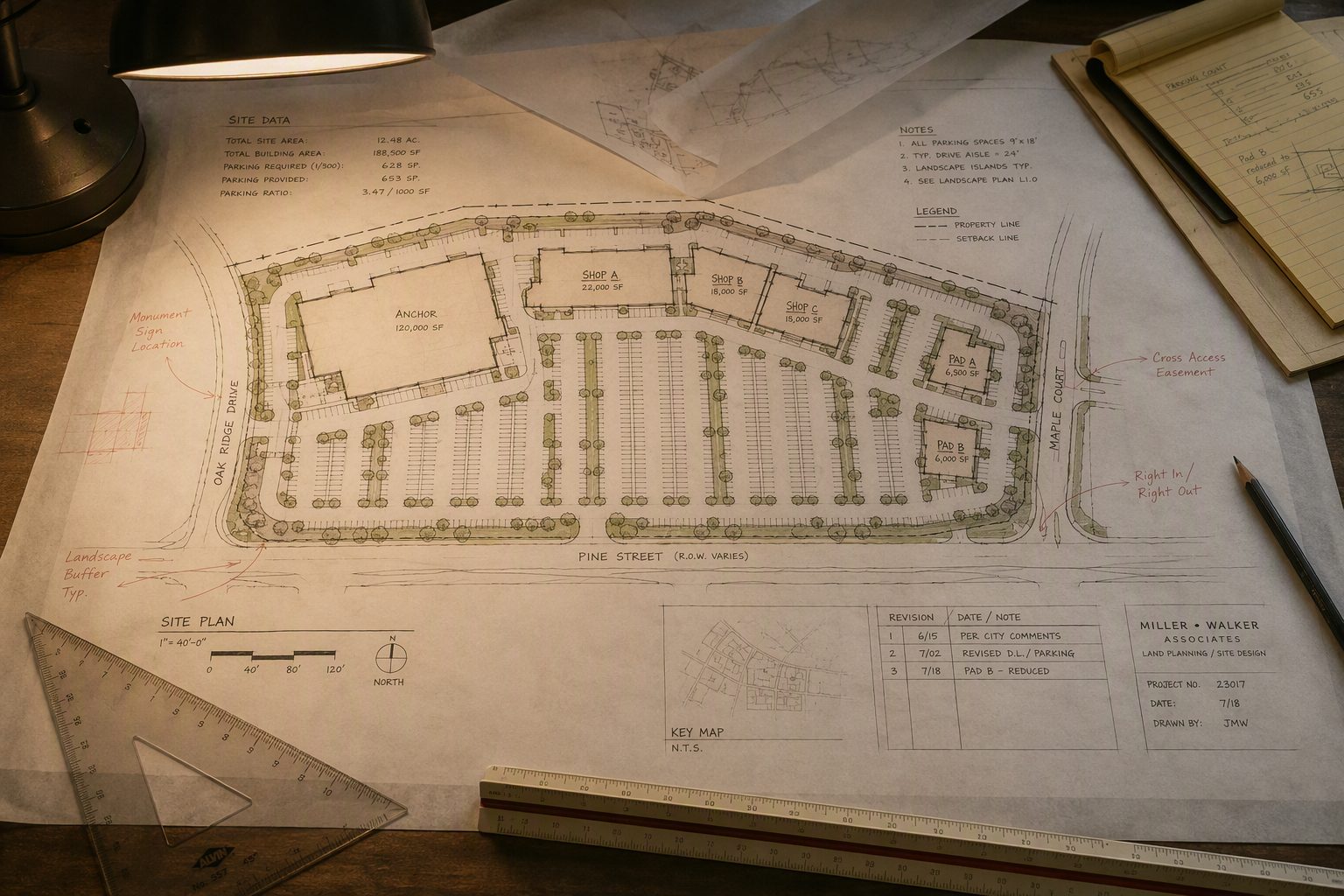
Most property management software is written for a portfolio imagined by a product team — standardized units, interchangeable tenants, abstract workflows. Then a real owner tries to load a real center into it: the parking variance from 1999, the reciprocal servitude with the bank, the anchor tenant’s HVAC contract obligation, the exclusive-use clause that overlaps two suites. The software handles the first 80% and quietly drops the rest. This article is the story of the opposite approach: a property management program built from the ground up around one specific, real shopping center — On The Blvd in Lafayette, Louisiana — and what that single-purpose build taught about operating systems generally. The program began life as “OTB Command” and now carries the name Command Platform; On The Blvd is its flagship deployment, and the code remains open on GitHub as the otb-command project.
Why build around one property
The decision was practical, not ideological. A legacy multi-tenant center carries an enormous amount of specific knowledge: recorded plats and easements, zoning conditions, lease obligations that differ suite by suite, vendor relationships, parking counts, access points. Generic software forces you to encode that knowledge as notes attached to generic records. A purpose-built tool encodes it as structure — the site plan is drawn from the plat, the compliance engine reflects the actual recorded documents, the critical-dates board reflects the actual lease population.
The bet was that building the system around the real property would produce something a generic platform never could: a tool where the drawing set is the interface. Property people already think in plans, sheets, and title blocks. So the program adopted the vernacular of a plan room rather than the vernacular of a CRM.
The sheets
The program is organized as a set of numbered sheets — the same discipline a drawing set uses. The set has grown from the original thirteen to eighteen (a portfolio rollup, a marketing sheet, a communications log, a matters board, and a procedures library joined the original set), but each sheet still answers one operating question. The explorer below walks the set:
Three design choices tie the sheets together. First, one source of truth: the rent roll, lease terms, and critical dates live once and feed every sheet that needs them, so a renewal date changed in the lease record moves itself to the dates board and the action board. Second, roles: the operator, the owner, vendors, and tenants each see a scoped view — a vendor sees its work orders, a tenant sees its unit’s maintenance items — without exposing the rest of the file. Third, persistence with portability: records sync to a hosted database, survive a browser change, and export as portable snapshots, so the owner is never locked into a vendor’s platform to reach the property’s own records.
The AI concierge, bounded
One sheet — the AI Concierge — deserves a careful explanation, because it is the clearest expression of the verification rule. The concierge answers questions against the property’s own documents: lease terms, vendor records, compliance status. Its context is assembled from the system’s records, not from the open internet, and its role is to prepare and point — summarize a clause, find the governing document, draft a first-pass notice for human review. It does not negotiate, approve, or send. The arrangement treats AI the way a well-run office treats a capable assistant: it reads everything, decides nothing.
What building it taught
Four lessons generalize beyond this one property:
- Structure beats features. The valuable parts are not clever; they are exact — the plat-proportioned site plan, the lease population reconciled against executed documents, the compliance items tied to their recorded sources.
- Persistence is the product. A tool that forgets on reload teaches the team to keep the real records elsewhere, and then the tool is dead. Mutation-survives-reload was a requirement from week one.
- Scope discipline matters. Building for one real center meant saying no constantly — no portfolio abstraction, no generic unit types, no feature that did not serve this property’s actual work. Almost every avoided feature proved to be a distraction in hindsight.
- The system and the articles are the same idea. This series argues that operations run on visible, dated, owned work. The program is simply that argument compiled into software.