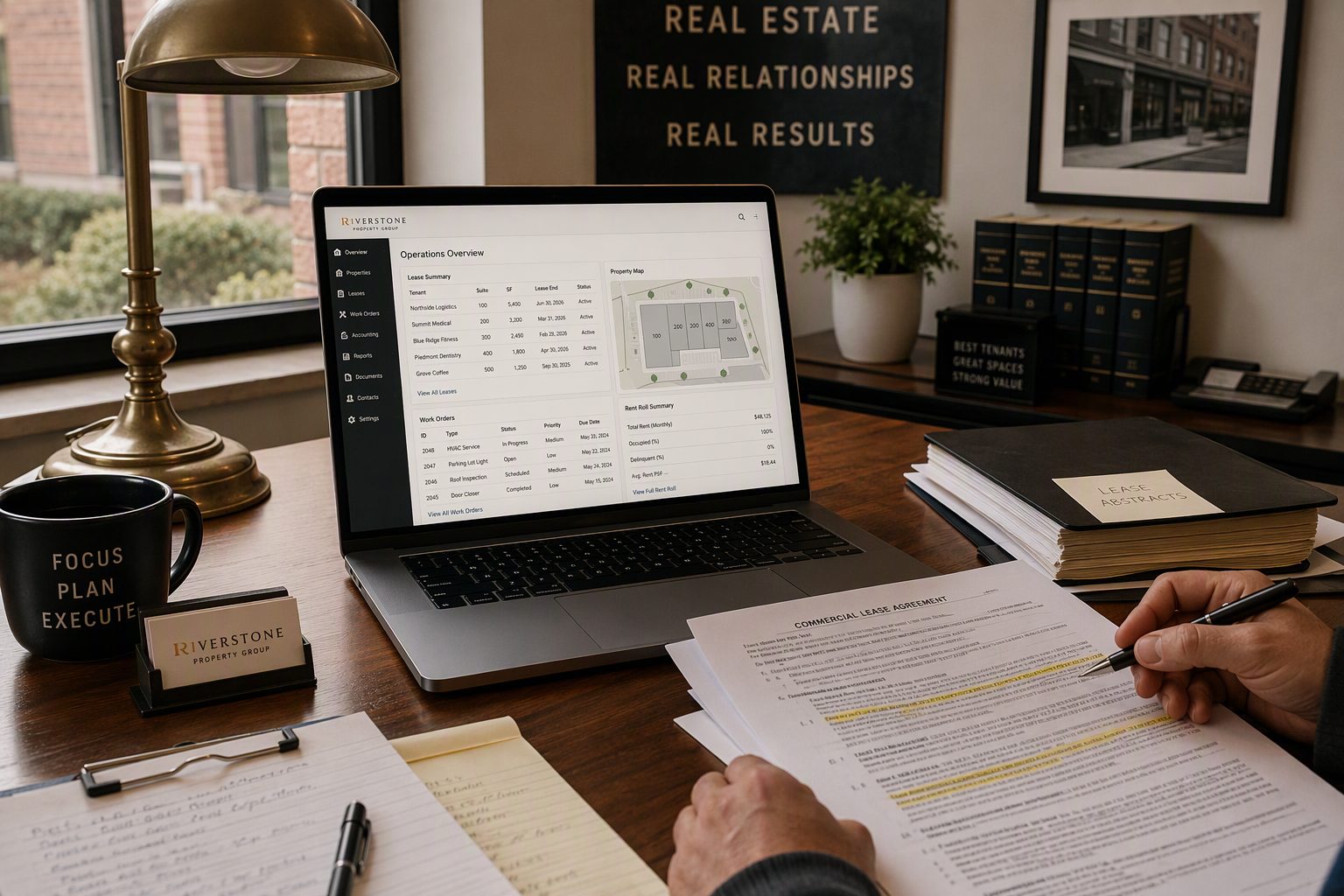
Every shopping center owner has heard that AI will change property management. Most of the coverage is useless for an operator, because it describes tools instead of work. This article takes the opposite approach. It starts from the recurring work of running a multi-tenant retail center — leases, vendors, renewals, reconciliations, reports — and maps where AI assistance genuinely reduces effort today, where it does not belong, and the one operating rule that keeps the whole arrangement honest.
Start with the work, not the tool
A shopping center generates a predictable stream of information work: leases arrive as long PDFs, vendor certificates expire on different dates, tenants ask questions that are answered in documents someone has to find, monthly owner reports assemble numbers from three sources, and every renewal season produces a stack of correspondence that needs drafting.
None of this work is glamorous. All of it is recurring. That combination — recurring, text-heavy, bounded — is exactly where AI assistance is strongest. The right question is never “how do we use AI?” It is “which of these recurring tasks involve reading, drafting, organizing, or comparing — and who is spending hours on them?”
Map the work first. List every recurring information task in a typical month, who does it, and roughly how long it takes. The map will almost always show the same pattern: a small number of high-judgment tasks (negotiations, approvals, capital decisions) and a larger number of bounded preparation tasks (summarizing, drafting, formatting, flagging). AI belongs on the second list.
Where AI genuinely helps
Four categories of work consistently repay the effort of setting up AI assistance in a property operation:
Summarizing. Lease abstraction is the clearest case. A full retail lease runs dozens of pages; a working abstract — dates, rent schedule, options, exclusives, CAM treatment, notice addresses — is one to two pages. AI can produce a solid first-pass abstract from an executed lease in minutes. The operator then verifies it against the source. Verification is not a formality; it is the job. But verifying a draft is far faster than writing from a cold start, and it catches nothing if nobody wrote the abstract at all.
Drafting. Routine tenant correspondence — renewal outreach, maintenance notifications, delinquency follow-ups, insurance certificate requests — follows recognizable patterns. AI drafts a competent first version in the operator’s voice; a person edits and sends. The time saving is real, but the larger benefit is consistency: every tenant gets a clear, complete, professional notice instead of a rushed one.
Organizing and preparing. Monthly owner reports, lender packages, and budget-variance notes all require assembling numbers and prose into a readable format. AI handles the assembly and the first draft of the commentary; the operator supplies the judgment about what the numbers mean and what action they imply.
Detecting patterns. Expense anomalies are the best example: a utility bill that doubles, a repair category trending upward for three months, an invoice that does not match a contract rate. Software with anomaly detection — or even a disciplined monthly review where AI flags outliers in the ledger — surfaces these early, when they are cheap to investigate.
Where to keep humans fully in charge
The boundary is not about the sophistication of the tool. It is about where accountability lives. Keep people fully in charge of:
- Negotiations and concessions. Every term exchanged with a tenant is a judgment call about the asset, the relationship, and the market. No draft tool should set your opening position.
- Anything that commits the ownership. Notices that exercise rights, approvals that spend money, letters that create obligations — a named person reads, decides, and signs. AI prepares; it never commits.
- Interpretation of rights and obligations. An AI summary of a lease clause is a pointer, not an opinion. When the answer matters — an exclusivity question, a CAM cap dispute, an option window — the operative documents get read in full, and counsel weighs in when the stakes justify it.
- Exceptions. The system routes routine work. Every exception — the tenant in distress, the vendor dispute, the insurance claim — goes to a person by design.
A useful test for any proposed AI use: if this output is wrong, who catches it, and when? If there is no good answer, the task is not ready for AI assistance.
The verification rule
Every working arrangement in this article rests on one rule: AI drafts, flags, and organizes; a named person reviews, decides, and sends. This rule protects three things at once. It protects the tenant, who receives accurate notices. It protects the owner, who remains the accountable party in every document the property produces. And it protects the team, whose judgment is the asset — the system exists to give that judgment better information and more room, not to replace it.
Build the rule into the workflow, not into hope. Practically: every AI-drafted document moves through a review step with a named owner; every AI-generated summary of a lease is checked against the source before it enters the file; and the team agrees that an unreviewed AI output is treated as unfinished work, not as a shortcut.