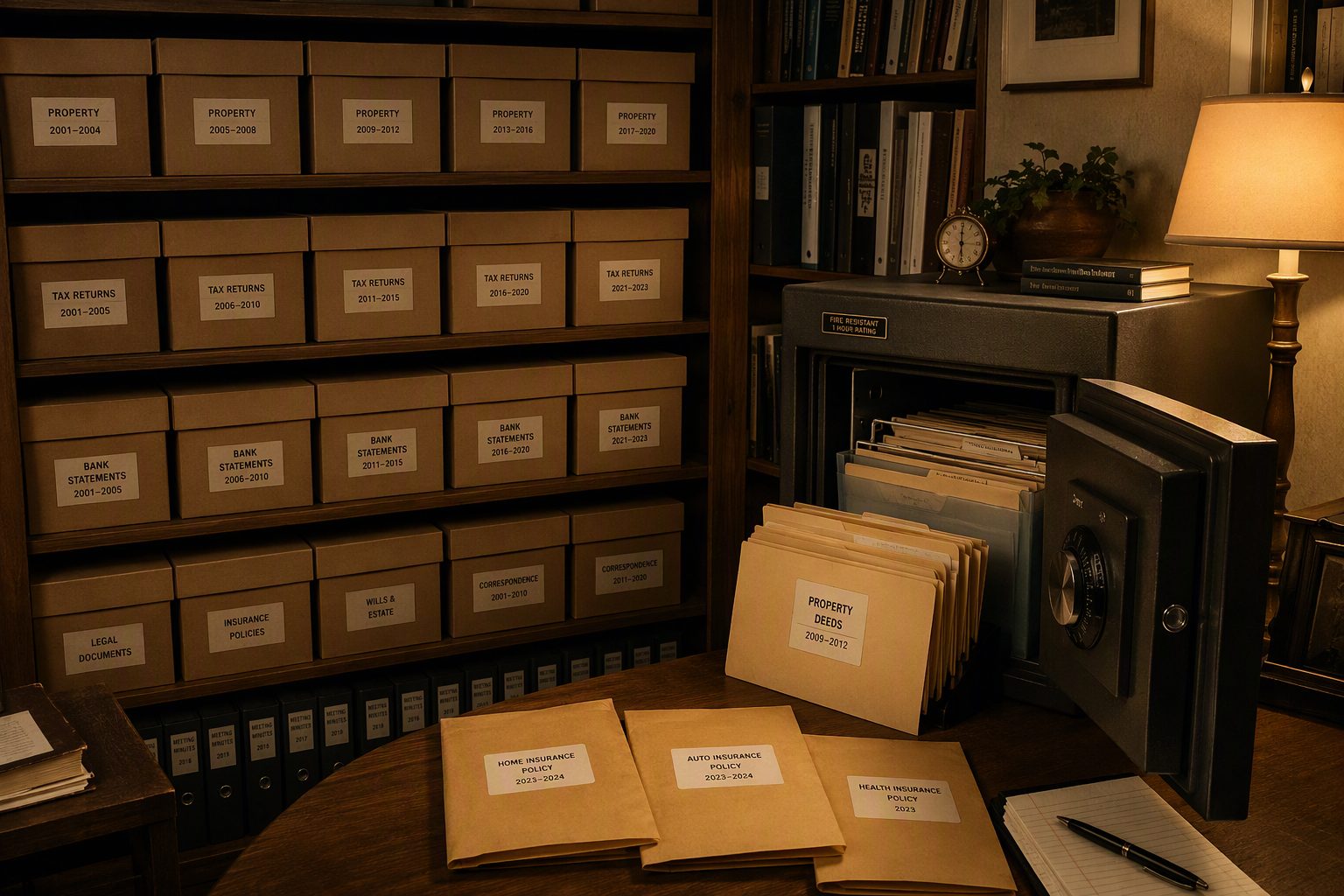
Ask most owners where their recorded warranty deed is, and the honest answer is a pause. Ask where the executed lease for Suite 107 is, and the pause gets longer. A shopping center’s documents are not administrative clutter — they are the asset’s legal memory: proof of what is owned, what is owed, what is insured, and what was agreed. When a dispute, a refinance, a sale, or a hurricane tests the file, the difference between a two-day answer and a two-month search is decided years earlier, in how the documents were kept. This article defines the owner document safe — what belongs in it, how to protect it, and an interactive checklist for auditing your own file.
What the safe is — and is not
The safe has two parts, and the distinction matters. The active file is the working system from Article 33: leases, abstracts, work orders, and vendor records that the team touches every week. The owner safe is the deeper vault — the documents that establish ownership, obligations, and coverage, updated rarely but demanded suddenly. A good rule: if losing the document would cost you money, rights, or weeks of reconstruction, it belongs in the safe.
The safe is also not a shoebox. It is a defined structure — physical, digital, or both — with a naming convention, a backup rule, and a named person responsible for keeping it current. “Somewhere in the lease folder” is not a safe; it is a hope.
The six families of documents
Every document in the safe belongs to one of six families:
- Entity and ownership — formation documents, operating agreements, resolutions, EIN records, and the chain of recorded instruments: deeds, the recorded plat, title policy, and closing documents. These prove the asset is yours and define who may act for it.
- Leases and tenants — every executed lease, amendment, side letter, and exhibit, plus estoppels, guarantees, and the lease abstracts that make the population searchable.
- Property and compliance — zoning and variance records, environmental reports, surveys, and certificates of occupancy. For a legacy center, this family often includes decades of inherited records; keep them even when their original purpose is forgotten.
- Insurance and risk — policies, renewals, certificates of insurance from tenants and vendors, claims and correspondence. Track every certificate’s expiration date in the active system; keep the historical record in the safe.
- Finance and tax — loan documents and amendments, appraisals, tax assessments and appeal records, and year-end financial statements. Lenders and buyers will ask for these in a defined window; retrieval should be minutes, not weeks.
- Operations and vendors — major service contracts (roof, HVAC, paving, landscaping), warranties on capital work, and as-built drawings. Warranties you cannot find are warranties you do not have.
The protection standard
Three practices move a file from “kept” to “protected.” First, redundancy in independent locations: a widely used standard is three copies, on two different media types, with one copy off-site — for example, the executed paper set in a fire-resistant container, a scanned set on an encrypted drive, and a cloud copy under an account the owner controls. Second, an access map: someone other than the owner must be able to find the safe and open it. Write the location, the structure, and the recovery steps on one page, sealed where a partner, attorney, or executor can reach it. Third, a refresh cycle: the safe is audited annually — new documents filed, superseded versions archived rather than deleted, and the access map updated.
A note on digital security
Store scans encrypted, with access limited to the people who genuinely need it, and use accounts with recovery controls the owner personally holds. This article is educational and does not address any specific platform’s security; the principle is simply that the same care given to the deed’s paper original should extend to its digital copy.